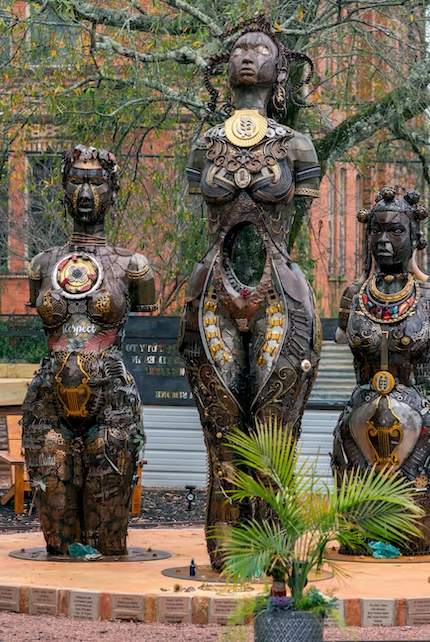
Honor Their Contribution, Say Their Names:
Anarcha, Betsey & Lucy
AMSA Reproductive Health Project eNews #64 – February 7, 2026
Greetings from the AMSA Reproductive Health Project!
Sending lots of AMSA love to you all as we live in and navigate a world increasingly destabilized by the violence and destructive power of globalized patriarchy. The myriad horrors of patriarchal abuses of power are actually on full display right now in so many ways. But rarely is it ever said out loud that every one of the existential crises facing humanity – including a crisis of depraved behavior by the capitalist class (exemplified by the grotesque crimes of sexual violence and human trafficking committed by Jeffrey Epstein and his network of billionaires and socio-political elite) – is connected through patriarchy. Patriarchy and patriarchal power structures have long existed in human societies, so it’s important to name with clarity what particular kind of patriarchy we encounter here in the US, specifically, and now also globally. We live in an era of the dominance of – to state the obvious – white supremacist heteropatriarchy.
“I often use the phrase ‘imperialist white-supremacist capitalist patriarchy’ to describe the interlocking political systems that are the foundation of our nation’s politics.” – bell hooks
We are here at the start of Black History Month, and in fact, this year is the 100th anniversary of national Black history commemorations, founded by Dr. Carter G. Woodson in 1926.
Black history month observations frequently focus on the stories of Black people’s enslavement, and the centuries-long fight for liberation and reparations, but I am mindful of the truth that the history of over 250 years of systematic trafficking, enslavement and raping of African and Black women, men, and children – the ultimate inhumanity of chattel slavery – is actually white people’s history, and in fact, is white people’s origin story. And it isn’t even history, in the sense that it is fully contained in the past; it’s all still here with us now in 2026 in full view. There’s a direct and unbroken line connecting the child rapists, traffickers, and enslavers Christopher Columbus, Thomas Jefferson, and Jeffrey Epstein. (And yes, it is absolutely fair and accurate to name Jeffrey Epstein as a modern-day enslaver, given what we know.)
It is undeniably, observably true that the existential crises of the world right now are the culmination of 500 years of unrestrained Euro-American white supremacist colonial-capitalism. Black people have long articulated the moral, ethical, and sociopolitical antidotes to the death-bringing systems of heteropatriarchal white supremacy. The antidotes and the medicines necessary to heal and transform this world ravaged by globalized white supremacist heteropatriarchy are found in intersectional feminism and a reorientation toward practices of collectivism.
That antidote takes one of its forms as the Reproductive Justice Movement, which was articulated and founded in 1994 by 12 Black women, known and honored as the Mothers of the Reproductive Justice Movement. Significantly, the RJ Movement is led by those most directly impacted by systemic oppression in a white supremacist heteropatriarchal society – Black and Indigenous women and femme people, queer people, and people of the global majority. The RJ Movement is a fight for the recognition of universal human rights, including bodily autonomy, the right to have children, the right to not have children, and the right to raise children and form families in a safe, supportive, and sustainable environment.
We in medicine need to take in this antidote, too, for we are a profession whose identity was born out of white supremacist heteropatriarchy and the presumed right of white men to be able to do with others’ bodies whatever they pleased.
The AMSA Reproductive Health Project’s work with future physicians toward the transformation of the medical profession is guided by the principles and practices of the Reproductive Justice framework, because the objectives in the fight for reproductive freedom and justice can be achieved – will be fully realized – only when white supremacist heteropatriarchal power structures are dismantled and replaced, in every facet of society, including medicine and healthcare.
In this month of commemoration of Black history, and in the next month, when we commemorate Women’s history, let us deeply consider the wisdom of Audre Lorde, who said,
“There is no such thing as a single-issue struggle because we do not live single-issue lives.”
And bell hooks, who said,
“Visionary feminism is a wise and loving politics. It is rooted in the love of male and female being, refusing to privilege one over the other. The soul of feminist politics is the commitment to ending patriarchal domination of women and men, girls and boys.
Love cannot exist in any relationship that is based on domination and coercion. Males cannot love themselves in patriarchal culture if their very self-definition relies on submission to patriarchal rules. When men embrace feminist thinking and practice, which emphasizes the value of mutual growth and self-actualization in all relationships, their emotional well-being will be enhanced.
A genuine feminist politics always brings us from bondage to freedom, from lovelessness to loving.”
Read on for more reflections and insights from the AMSA Reproductive Health Project Fellow, Dr. Taylor Spears, on the connections between Black History Month and the Reproductive Justice Movement in this issue’s Spotlight.